Family Therapy Benefits: How It Helps Families Heal Together
When a family is struggling, it can feel like everyone is talking, but no one is really being heard. A disagreement about something small can quickly become an argument about everything that has gone wrong over the years. Eventually, people may stop talking altogether because it feels easier than dealing with another fight.
I often remind families that conflict does not necessarily mean something is fundamentally wrong with the family. Sometimes, it means the family has developed patterns that are no longer working.
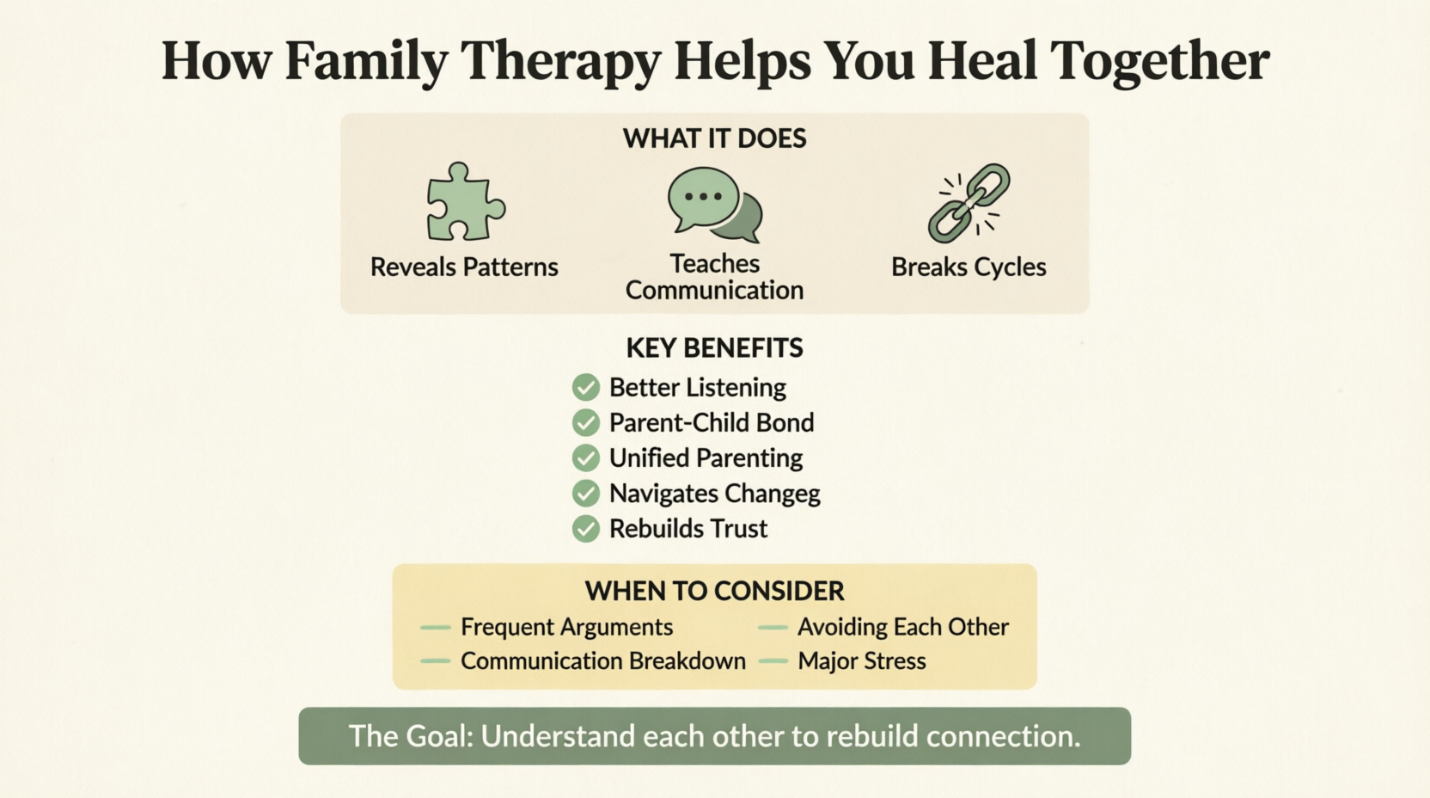
This is where family therapy can help. The family therapy benefits are not simply about resolving one argument. Therapy can help family members understand what is happening beneath the conflict, communicate differently, and rebuild a sense of connection at home.
Knowing What Is Really Happening in Your Family
When families come to therapy, there is often one person who has been identified as “the problem.” Maybe it is a teenager who keeps acting out, a parent who seems overly controlling, or an adult child who has become distant.
But family dynamics are rarely that simple.
I look at what happens between family members rather than placing all the responsibility on one person. How does one person's reaction affect another? What happens immediately before an argument? Who withdraws, who pursues, and who tries to keep everyone happy?
These patterns can become so familiar that families stop noticing them.
One of the most important family therapy benefits is gaining the ability to recognize those patterns. Once you can see what is happening, you can begin making different choices instead of automatically repeating the same cycle.
Learning to Communicate Without Making Things Worse
Many families love each other deeply but have never learned how to communicate during difficult moments.
A parent may try to correct a child, only to have the child become defensive. The parent becomes frustrated and raises their voice. The child withdraws. The parent follows up with more questions. Before long, everyone is angry, and no one feels understood.
In family counseling, we slow this process down.
I help family members learn to express what they are actually feeling and needing without immediately turning the conversation into criticism or blame.
This can include learning to:
Listen without interrupting
Express emotions more clearly
Ask questions instead of making assumptions
Identify when a discussion is starting to escalate
Respond to another person's feelings without immediately trying to fix them
These are practical skills that can be used long after a therapy session ends.
Breaking Patterns That Have Been Passed Down
Sometimes the way you communicate with your family has very little to do with the conversation happening today.
You may be responding from what you learned growing up.
Perhaps your parents never talked about difficult emotions, so you learned to keep everything inside. Maybe conflict in your childhood home was loud and unpredictable, so you now avoid disagreement at all costs. Or perhaps you learned that being a “good” family member meant keeping everyone else happy.
These patterns can quietly move from one generation to another.
Family therapy gives you an opportunity to recognize what you have inherited without blaming the people who came before you. You can understand where these behaviors came from and decide whether they still belong in your family today.
That awareness can be one of the most meaningful family therapy benefits because change within one generation can influence the generations that follow.
Helping Parents and Children Understand Each Other
When a child or adolescent faces challenges, it’s often tempting to concentrate exclusively on their actions.
They may be angry, withdrawn, argumentative, or unwilling to follow expectations. Parents can understandably become frustrated and wonder, “Why won't they just listen?”
I encourage families to look underneath the behavior.
Sometimes a child is communicating distress in the only way they know how. Sometimes a parent is reacting from fear, exhaustion, or a genuine desire to protect their child.
Therapy for families creates space for both perspectives.
We can work on parent-child communication, boundaries, emotional regulation, expectations, and the patterns that turn ordinary disagreements into power struggles. The goal is not to make parents or children “win.” It is to help them understand each other well enough to respond differently.
Creating a Healthier Parenting Partnership
Parenting disagreements can create tension throughout an entire household.
Maybe one parent believes in strict consequences while the other tends to be more lenient. Perhaps you disagree about screen time, discipline, responsibilities, or how much independence your child should have.
You do not have to agree on every parenting decision to work well as a team.
Family counseling can provide a place to discuss those differences without putting children in the middle. When parents develop clearer communication and a more consistent approach, children often have a better understanding of what is expected of them.
The goal is not perfect agreement. It is creating enough consistency and trust that the family can move forward together.
Finding Your Way Through Major Family Changes
Families can experience significant stress during divorce, remarriage, relocation, loss, career changes, or other major transitions.
Everyone may experience the same event differently.
One person may feel relieved while another feels frightened. A parent may be focused on practical responsibilities while a child is grieving what feels like the loss of normal life.
Family therapy provides a place for those experiences to be acknowledged rather than pushed aside.
If you are preparing for marriage or building a family, you may also benefit from learning what is premarital counseling. Preparing for major relationship transitions can help couples develop stronger communication and expectations before new challenges arise.
Repairing Old Hurt and Rebuilding Trust
Not every family conflict is about something that happened yesterday.
Sometimes, the argument happening today is connected to something that happened years ago.
An unresolved disappointment, broken promise, or painful family experience can continue shaping how someone interprets everything that happens afterward. Even when nobody talks about it anymore, the hurt may still influence the relationship.
Family conflict resolution does not mean pretending those experiences never happened.
It means creating space to understand the hurt, take responsibility where appropriate, establish healthier boundaries, and determine what a healthier relationship can look like moving forward.
Sometimes that means rebuilding closeness. Sometimes it means learning to relate differently while maintaining appropriate boundaries.
When Is Family Therapy Worth Considering?
You do not need to wait until your family reaches a breaking point.
Family therapy may be worth considering if:
Arguments are becoming more frequent or intense
Family members are avoiding one another
Communication repeatedly breaks down
Parenting disagreements are affecting the household
Old resentment continues to influence current relationships
A major life transition has created tension
You feel like you have tried everything on your own
Sometimes asking for help is not a sign that your family has failed. It is a sign that you care enough about the relationships to approach them differently.
FAQs
What are the main benefits of family therapy?
Family therapy can help improve communication, address recurring conflict, strengthen relationships, establish healthier boundaries, and help family members understand one another's experiences.
Who should participate in family therapy?
The appropriate participants depend on the situation. Therapy may involve parents and children, siblings, adult children and parents, blended families, or other family members affected by the conflict.
Does family therapy work if one person refuses to attend?
In some situations, therapy can begin with the family members who are willing to participate. Changes in one part of the family system can sometimes influence the broader dynamic.
Is family therapy only for families in crisis?
No. Families may seek support during transitions, parenting challenges, communication difficulties, or periods of growing tension. You do not have to wait for a crisis to ask for help.
Helping Your Family Find a Healthier Way Forward
Your family does not have to communicate perfectly to have a strong relationship. What matters is being willing to understand the patterns that are creating distance and learning new ways to respond to one another.
The family therapy benefits can extend far beyond the therapy room. When family members learn to communicate with greater awareness, repair old hurts, and create healthier boundaries, those changes can influence how the family handles challenges for years to come.
At Turner Counseling LLC, I provide a compassionate and clinically grounded space where families can work through conflict, strengthen communication, and reconnect. If your family has been stuck in the same cycle for too long, you do not have to figure out the next step alone.
Sometimes healing begins with simply having a safe place to start the conversation.