Marriage Counseling vs. Couples Therapy: Key Differences & How to Choose
Couples searching for help often land on two terms and immediately wonder which one applies to them. Marriage counseling vs. couples therapy. Are they the same thing? Does the distinction matter? And more practically, which one do you actually need?
I hear these questions frequently. The short answer is that the terms are frequently used interchangeably, but there are meaningful differences worth understanding before you choose a path forward.
Where the Couples Therapy vs. Marriage Counseling Confusion Comes From
The overlap is real. Both involve a licensed therapist working with two partners. Both address communication, conflict, and connection. Both can happen in the same therapist's office, sometimes even in the same session series.
The confusion exists largely because the mental health field hasn't standardized the terminology. Different therapists use these labels differently, and the internet doesn't help. But beneath the surface, there's a distinction that matters for how you approach the process and what you expect from it.
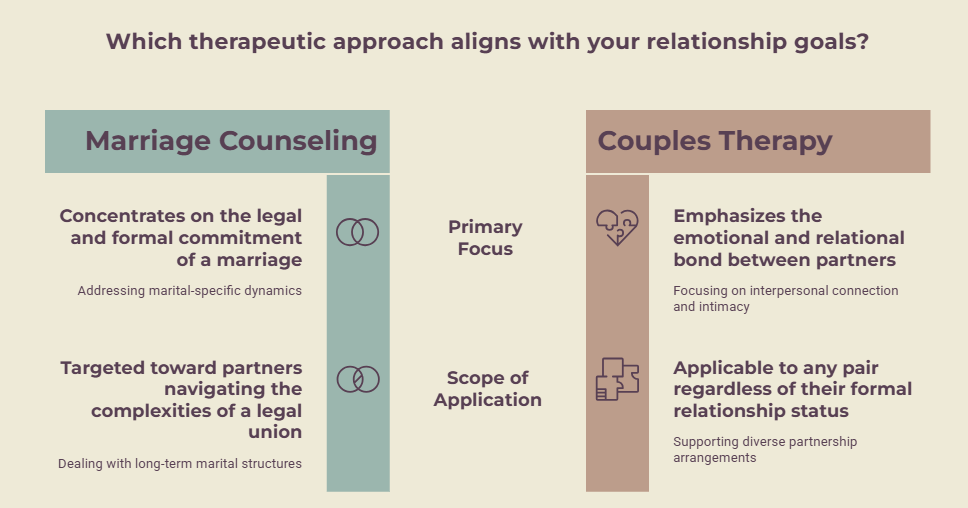
What Marriage Counseling Typically Focuses On
Marriage counseling tends to be more present-focused and solution-oriented. It's generally sought when a specific problem has surfaced in the relationship, and the couple wants structured help addressing it.
Common reasons couples come to me for marriage counseling include:
· A breakdown in communication that has become a recurring pattern
· Restoring confidence following a betrayal or violation of trust
· Navigating a major life transition together, such as a new child, job loss, or relocation
· Disagreements around finances, parenting, or family boundaries
· A growing sense of disconnection that neither partner knows how to reverse
The focus is practical. We identify what's happening, understand why it keeps happening, and work toward concrete changes. It's not about dissecting your entire childhood. It's about improving how your relationship functions right now.
What Couples Therapy Typically Involves
Couples therapy tends to go deeper. It's broader in scope and often explores the emotional and psychological patterns each partner brings into the relationship, including the ones formed long before you met each other.
This is where family-of-origin dynamics come in. How did your parents handle conflict? What did love look like in your household growing up? What unconscious beliefs do you carry about what a partner is supposed to do, feel, or provide?
The difference between marriage counseling and couples therapy isn't always about the couple's legal status. It's more about depth and duration. Couples therapy is often a longer process, and it's particularly valuable when surface-level fixes haven't held because the deeper patterns were never addressed.
Couples Therapy vs. Marriage Counseling: A Practical Comparison
Here's a straightforward way to think about how they differ in practice:
| Marriage Counseling | Couples Therapy | |
|---|---|---|
| Focus | Specific issues, present conflicts | Deeper patterns, emotional history |
| Duration | Often shorter-term | Can be longer-term |
| Best for | Identified problems needing resolution | Recurring cycles with unclear roots |
| Approach | Solution-focused | Exploratory and insight-driven |
In my practice, I don't treat these as rigid categories. I begin by identifying the pattern of the problem, helping both partners understand the primary issues, and then shaping the process around what your relationship actually needs. That might look more like counseling early on and shift toward deeper therapeutic work as we progress.
Is Marriage Counseling Worth It?
This is one of the most honest questions I get asked, and it deserves a direct answer.
Yes, marriage counseling is worth it when both partners come in genuinely willing to engage. Research consistently supports that structured couples work improves relationship satisfaction, communication, and emotional connection.
The American Association for Marriage and Family Therapy reports that over 97% of couples surveyed said they got the help they needed from marriage and family therapy, and nearly 93% reported having more effective tools for dealing with their problems.
But I want to be honest about something. The outcome depends significantly on both partners' openness to the process. One person can't do this work for two. What I can do is create a space where both of you feel genuinely heard and understood, not judged, not managed.
For couples who share a faith background, that space also includes room for your spiritual values. I integrate faith into the therapeutic process when it's meaningful to the people I'm working with, because honoring the whole person matters.
Why Marriage Counseling Often Works Better Sooner
One thing I've observed consistently is that couples tend to wait too long. By the time many couples come to see me:
· They've been managing a painful dynamic for years.
· Resentment has built.
· Distance has settled in.
· Communication has narrowed to logistics.
It’s Never Too Late to Start
That doesn't mean it's too late. But it does mean the work is harder than it needed to be.
Reaching out earlier, when the frustration is real but the damage is still limited, gives the process more room to work. If you're on the fence about whether things are serious enough to warrant help, that uncertainty itself is usually reason enough to have a conversation.
This connects to something I also see in my individual counseling work. Personal patterns that go unexamined don't stay contained. They surface in relationships. Addressing them, whether individually or together, is one of the most valuable things you can do for the partnership.
How to Choose What's Right for You
If you're trying to decide between marriage counseling and couples therapy, here are a few honest questions worth sitting with:
· Is there a specific issue driving your decision to seek help, or does the disconnection feel more general?
· Have you tried resolving this before and found yourselves back in the same place?
· Are you both coming in willing to look at your own role in the dynamic?
· Do individual patterns, anxiety, past experiences, or family history seem to be influencing the relationship?
Your answers will point toward the kind of support that fits. And if you're still unsure, that's exactly what an initial consultation is for. We talk, I listen, and together we figure out what makes the most sense for where you are right now.
You can also explore more about how I approach couples therapy and the specific benefits of premarital counseling if you're earlier in the relationship journey.
FAQs
What is the difference between marriage counseling and couples therapy?
Marriage counseling tends to focus on specific present-day issues and is often shorter-term. Couples therapy goes deeper into emotional patterns and relationship history. In practice, many therapists use the terms interchangeably, but the approach differs based on what the couple needs.
Is marriage counseling worth it?
For most couples who engage honestly with the process, yes. Research from the AAMFT shows high satisfaction rates among couples who pursue therapy together. The key factor is both partners' genuine willingness to participate.
Why marriage counseling rather than working things out alone?
A skilled therapist offers structure, tools, and an objective perspective that friends and self-help resources rarely provide. Many couples find that conversations they've had dozens of times at home shift significantly when guided by a trained professional.
Can unmarried couples go to marriage counseling?
Absolutely. The term "marriage counseling" applies to committed couples regardless of legal status. If you're in a long-term relationship and want to work on it together, you don't need to be married to benefit from the process.
How long does marriage counseling take?
It depends on the couple and the concerns involved. Some couples see meaningful progress in six to eight sessions. Others work together for several months. I shape the timeline around your specific needs rather than following a fixed structure.
The Right Support Changes Everything
Whether you're navigating a specific challenge or trying to understand a pattern that keeps repeating, the right support makes a real difference. You don't have to keep having the same argument or sitting with the same distance, hoping it resolves on its own.
If you're ready to take the first step, I'd love to hear what's going on. Schedule your free 30-minute consultation with me at Turner Counseling, and let's figure out together what kind of support makes the most sense for you and your partner.