Different Types of Trauma Therapy Explained: Which One Is Right for You?
Walking into therapy for trauma can feel overwhelming enough without trying to decode acronyms like ART, CPT, SE, and IFS. If you're researching different types of trauma therapy, you've probably noticed that every approach claims to be effective, and honestly, many of them are.
But effectiveness isn't just about research outcomes; it's about what works for your specific nervous system, trauma history, and preferences. Knowing the main therapeutic approaches can help you make an informed choice about where to start your healing journey.
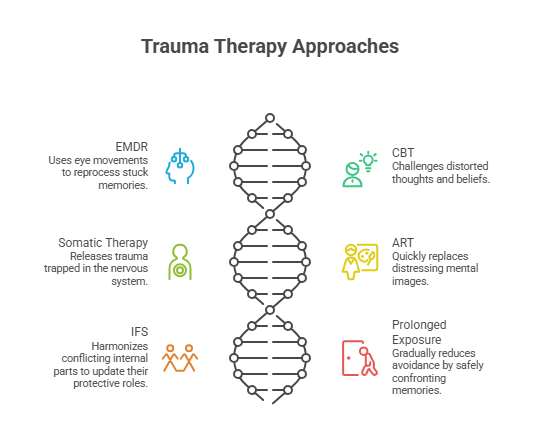
EMDR Therapy for Reprocessing Through Bilateral Stimulation
Eye Movement Desensitization and Reprocessing sounds complicated, but the concept is fairly straightforward. EMDR therapy uses bilateral stimulation, usually following a therapist's finger with your eyes, or alternating tactile taps, while you recall traumatic memories.
This dual attention somehow allows your brain to reprocess stuck memories. The traumatic experience gets "digested" and filed away as a past event rather than a current threat. You're not trying to change what happened or talk yourself into feeling differently. You're literally changing how the memory is stored in your brain.
EMDR works particularly well for:
Single-incident traumas (car accidents, assaults, natural disasters)
People who struggle to verbalize their experiences
Those who want a relatively time-limited approach
Individuals with vivid, intrusive memories that feel stuck
According to research from the American Psychological Association, EMDR shows strong effectiveness for PTSD treatment, often with fewer sessions than traditional talk therapy approaches.
Cognitive Behavioral Therapy for Changing Thought Patterns
CBT therapy for trauma focuses on the connection between thoughts, feelings, and behaviors. Traumatic experiences create distorted beliefs: "I'm not safe," "I can't trust anyone," "It was my fault." CBT helps you identify these patterns and challenge them with evidence.
Cognitive Processing Therapy, a specific type of CBT, is especially designed for trauma. You learn to recognize "stuck points" beliefs that keep you trapped in trauma responses. Through written exercises and guided discussion, you examine whether these beliefs hold up to scrutiny.
The approach is structured and homework-intensive. You'll practice skills between sessions, write about your trauma, and actively challenge unhelpful thoughts. For people who like clear frameworks and measurable progress, CBT therapy offers exactly that structure.
CBT approaches work well for:
People who prefer logical, structured interventions
Those comfortable with homework assignments and written exercises
Individuals whose trauma created specific distorted beliefs
People who want to understand the "why" behind their responses
One limitation: CBT is heavily cognitive, which means it might miss trauma stored in the body. Some people need more body-focused trauma therapy before they can engage with cognitive work effectively.
Somatic Therapy for Releasing Trauma from the Body
Somatic therapy operates on a simple premise: trauma lives in your body, not just your mind. Your nervous system holds the imprint of what happened, often showing up as chronic tension, pain, or physical symptoms that doctors can't explain.
Somatic Experiencing, developed by Peter Levine, focuses on physical sensations and completing self-protective responses that got interrupted during trauma. When something threatening happens, your body prepares to fight or flee. But if you couldn't do either, if you froze or had to stay still, that survival energy gets trapped.
In somatic therapy sessions, you pay close attention to body sensations. Where do you feel tension when you think about the trauma? What happens in your chest, your stomach, your jaw? Instead of just talking about these sensations, you work with them, allowing stuck energy to discharge safely.
Somatic approaches work well for:
People with chronic physical symptoms related to trauma
Those who dissociate or feel disconnected from their bodies
Individuals who've tried talk therapy without full relief
People whose trauma happened pre-verbally or before they could form clear memories
I've worked with clients whose chronic back pain vanished after somatic processing, not because we focused on the pain itself, but because we addressed the trauma their body was holding. Sometimes your body needs to complete the story before your mind can move on.
Accelerated Resolution Therapy (ART) for Brief and Directive Processing
Accelerated Resolution Therapy (ART) is a newer, structured approach that combines elements of eye movements with guided imagery.
Like EMDR therapy, ART uses bilateral eye movements. However, ART includes a distinctive component called voluntary image replacement. Clients are guided to replace distressing imagery with neutral or positive alternatives while maintaining the factual memory.
ART often appeals to individuals who:
Prefer shorter treatment models
Want a more directive structure
Feel overwhelmed by prolonged narrative work
Respond well to visualization techniques
One advantage of ART is that clients do not need to describe traumatic events in detail. The work happens internally with therapist guidance.
Internal Family Systems for Working with Your Parts
Internal Family Systems takes a different angle entirely. Instead of viewing trauma as something to be processed and eliminated, IFS recognizes that different parts of you developed in response to trauma, and they all make sense.
The part that's still terrified. The part that's furious. The part that wants to pretend nothing happened. The part that keeps you numb so you don't have to feel anything. IFS creates internal dialogue between these parts, helping them work together instead of fighting each other.
You learn to approach your internal experience with curiosity rather than judgment. Each part had a role in keeping you safe, even if that role now causes problems. The goal isn't eliminating parts but helping them update their jobs for your current life rather than your traumatic past.
IFS works particularly well for:
People who feel conflicted or "at war with themselves"
Those with complex trauma involving multiple experiences
Individuals who've developed distinct coping strategies that now clash
People drawn to more exploratory, less directive approaches
Prolonged Exposure for Gradual Desensitization
Prolonged Exposure therapy operates on the principle that avoidance maintains trauma symptoms. When you avoid reminders of what happened, you never learn that the memory itself can't hurt you. PE gradually and repeatedly exposes you to trauma memories and reminders in safe contexts.
This doesn't mean re-traumatizing yourself. It means carefully approaching what you've been avoiding, first in imagination, then sometimes in real life, until your brain recognizes that remembering isn't the same as re-experiencing.
You might retell your trauma narrative repeatedly, adding more details each time. Between sessions, you'll listen to recordings of these narratives. You'll also create a hierarchy of avoided situations and gradually approach them, starting with the least distressing.
PE works well for:
People whose avoidance significantly limits their lives
Those motivated to do intensive between-session work
Individuals who want a time-limited, structured protocol
People with PTSD who can tolerate gradual exposure to distressing material
The approach requires commitment. You'll feel worse before you feel better as you stop avoiding. But research shows PE produces lasting changes when completed fully.
How to Decide Which Therapy Fits You
Choosing between ART therapy, CBT therapy, and somatic therapy depends on several factors.
· You might lean toward ART therapy if specific memories feel vivid and intrusive.
· CBT therapy may fit if your primary struggle involves self-blame, rigid beliefs, or avoidance behaviors.
· Somatic therapy may be helpful if your trauma shows up physically through tension, panic, or dissociation.
Many therapists integrate elements from multiple models. Knowing how does trauma therapy work at a broader level can clarify how these approaches overlap in structure even when techniques differ.
Frequently Asked Questions
Who is not suited for ART?
ART may not be suitable for individuals with certain neurological conditions, such as uncontrolled seizures, or those who are not yet emotionally stable enough to handle the processing phase. A qualified therapist will always perform a thorough screening to ensure you have the necessary coping tools before starting.
What are the 7 major traumas?
While trauma is unique to the individual, clinical circles often recognize seven major categories: childhood abuse, medical trauma, natural disasters, sexual violence, community violence, domestic violence, and the sudden loss of a loved one. Each can significantly impact the nervous system.
What is the most effective therapy for trauma?
There is no single "most effective" therapy, but ART is widely considered the gold standard for rapid and lasting relief. The most effective path is the one that prioritizes your safety and matches your specific symptoms and goals.
How many sessions do different types of trauma therapy usually take?
The timeline varies. Specialized methods like ART can often show results in as little as 1 to 5 sessions. More complex, long-standing trauma from childhood may require several months of consistent work to achieve deep, sustainable healing.
Find Your Starting Point
Understanding different types of trauma therapy helps you make informed choices, but you don't need to have it all figured out before reaching out. A good trauma therapist will assess your needs and recommend approaches that fit your situation.
Turner Counseling LLC offers multiple evidence-based trauma therapies, allowing us to tailor treatment to your specific needs rather than using a one-size-fits-all approach. Whether you're drawn to ART therapy, somatic therapy, CBT therapy, or a combination, we'll work together to find what helps you heal.
You've already taken the first step by educating yourself. The next one is reaching out to see what might work for your unique healing journey.