Does Couples Counseling Work? What Research and Therapists Say
When your relationship is struggling, couples counseling might feel like a last-ditch effort or a waste of time and money. You've probably heard conflicting stories, friends who swear therapy saved their marriage, and others who say it just prolonged the inevitable breakup.
So does couples counseling work, or is it just an expensive way to delay a decision you've already made? The research is actually quite detailed: couples therapy has a strong success rate when both partners engage genuinely, but it's not magic.
So, let’s take a look at what the couples therapy success rate is and how effective it can be.
What the Research Actually Shows About Couples Counseling Effectiveness
When we look at the couples therapy success rate, the data is actually very encouraging for those who are willing to put in the work.
Modern methods have moved away from simple "venting sessions." For example, research into Emotionally Focused Therapy (EFT) shows that about 70% to 75% of couples move from a state of distress to a state of recovery. This is a significant margin that highlights the power of addressing the emotional core of a relationship.
But here's the nuance: "success" doesn't always mean staying together. Sometimes couples therapy helps partners recognize they're fundamentally incompatible and facilitates a healthier separation. Other times it resolves long-standing conflicts and restores intimacy. Both outcomes can be considered successful depending on what serves the individuals involved.
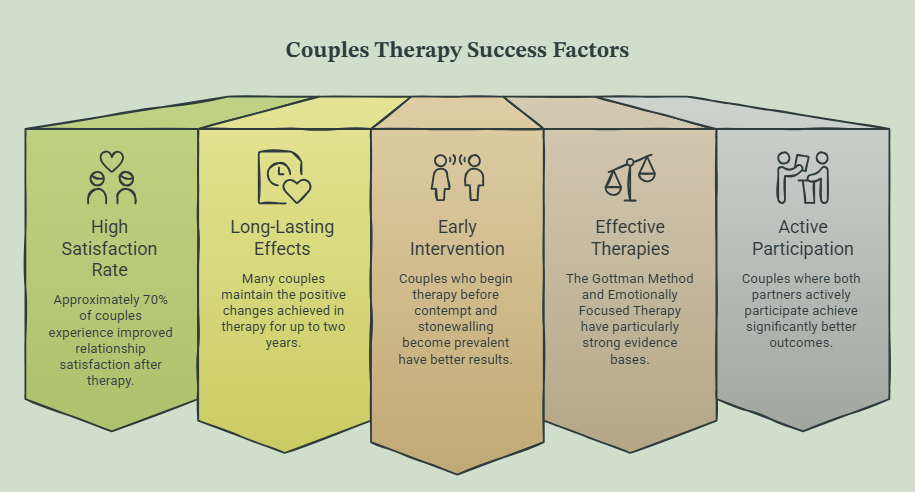
Research Findings on Couples Therapy Success Rate
About 70% of couples report improved relationship satisfaction after therapy
Effects tend to last, with many couples maintaining gains two years post-treatment
Couples who start therapy earlier in conflict (before contempt and stonewalling dominate) have better outcomes
The Gottman Method and Emotionally Focused Therapy show particularly strong evidence bases
Couples who both actively participate do significantly better than those where one partner is reluctant
One important finding: the therapist's skill and approach matter enormously. Not all couples counseling is equal. Therapists specifically trained in evidence-based couples interventions produce better outcomes than general therapists who occasionally see couples.
Situations Where Couples Counseling is Most Effective
Does couples counseling work for every relationship? Not in every situation. But certain conditions make success significantly more likely. The strongest predictor is both partners' genuine willingness to engage with the process, even when it's uncomfortable.
Couples therapy works best when you're addressing specific patterns or conflicts rather than fundamental incompatibility. If you fight about the same things repeatedly, struggle with communication, or feel disconnected but still care about each other, therapy has excellent potential to help.
When Does Couples Counseling Work Best
Communication breakdowns where you talk past each other or escalate quickly
Loss of intimacy or emotional connection despite still caring for each other
Specific conflicts around money, parenting, or life direction
Rebuilding trust after betrayal when both partners want to repair
Life transitions causing relationship stress (new baby, career changes, relocation)
Breaking negative cycles before they become entrenched
The timing matters too. Couples who seek help when they first notice persistent problems do better than those who wait until contempt, defensiveness, and emotional disengagement have taken root. By the time many couples reach therapy, they've spent years reinforcing destructive patterns that take longer to unravel.
That doesn't mean late-stage help is pointless. I've seen couples rebuild after decades of dysfunction, but earlier intervention typically requires less intensive work.
What Undermines Marriage Counseling Effectiveness
Even when couples therapy has potential to help, certain factors significantly reduce the chances of success. The biggest predictor of failure is one partner attending only to appease the other while having no genuine intention to change or engage.
If you're going to therapy to prove you're right and your partner is wrong, you're wasting everyone's time and money. Couples counseling isn't a courtroom where the therapist declares a winner. It's a process for understanding each other's experiences, identifying destructive patterns, and learning new ways of relating.
Common Factors That Affect the Success
One or both partners already decided to leave but haven't said so
Active affairs or addiction that aren't being addressed
Abuse dynamics that make honest communication unsafe
Expecting the therapist to "fix" your partner rather than examining your own contributions
Unwillingness to practice new skills or complete assignments between sessions
Timing issues can also undermine effectiveness. Starting couples therapy while in the midst of a major crisis (job loss, serious illness, family emergency) means you're both depleted and have little bandwidth for relationship work. Sometimes individual support or crisis stabilization needs to come first.
Another factor: mismatched goals. If one party wants to save the marriage and the other wants help ending it amicably, therapy can still be valuable but requires different focus and expectations.
If you are currently questioning is marriage counseling worth it, consider that the cost of staying stuck is often much higher than the investment of therapy. Rebuilding your partnership requires effort, but the relief of finally feeling like you are on the same team again is worth the work.
Couples Counseling FAQs
What is the success rate of couple counselling?
Research generally shows that about 70% to 75% of couples experience a positive improvement in their relationship satisfaction when using evidence-based methods like EFT. The success depends heavily on the timing of when you start and the commitment of both partners.
Does couples therapy work after cheating?
Yes, it is possible to rebuild a relationship after infidelity, provided both partners are committed to total transparency and the long-term work of rebuilding trust. Therapy provides a safe structure for the difficult conversations and emotional processing required for healing.
How much does couples therapy cost?
Without insurance, couples therapy typically costs $150-$300 per session, with most couples starting at weekly sessions. This means $600-$1,200 monthly initially. With insurance, costs vary widely, some plans cover couples therapy while others don't. Many therapists offer sliding-scale fees. Total investment might range from $2,000-$10,000+ depending on duration and frequency.
How do I know if my therapist is a good fit?
You should both feel that the therapist is neutral, professionally respected, and humanly met in your sessions. If one person feels "ganged up on," it is important to address that feeling immediately to maintain the clinical bond.
What if my partner refuses to come to therapy?
While it is best if both people are present, you can still see positive shifts by attending individual therapy. When one person changes their reactions and communication style, it often forces the relationship "system" to adjust as well.
Rebuild Your Bond with Turner Counseling LLC
You do not have to keep living in a state of constant conflict or emotional distance. I am ready to provide the clinical expertise and the compassionate support you need to answer the question, does couples counseling work, for your own relationship.
I invite you to take the first step toward a healthier partnership now. Contact Turner Counseling LLC to schedule your free 30-minute consultation. Let’s work together to help you find the peace and the connection you’ve been searching for.