Do I Need Trauma Therapy? Signs It's Time to Seek Professional Help
If you’ve found yourself typing do I need trauma therapy into Google late at night, you’re probably not looking for a dramatic answer. You’re looking for clarity.
Trauma is often quieter than people expect. It can show up as tension, avoidance, irritability, or numbness rather than flashbacks.
I’ve worked with many clients who weren’t sure their experiences “counted.” What helped them most wasn’t a label. It was understanding how unresolved stress lives in the body and mind. Let’s walk through what to look for and how to decide your next step.
If you’ve found yourself typing do I need trauma therapy into Google late at night, you’re probably not looking for a dramatic answer. You’re looking for clarity.
If you’ve found yourself typing do I need trauma therapy into Google late at night, you’re probably not looking for a dramatic answer. You’re looking for clarity.
Trauma is often quieter than people expect. It can show up as tension, avoidance, irritability, or numbness rather than flashbacks.
I’ve worked with many clients who weren’t sure their experiences “counted.” What helped them most wasn’t a label. It was understanding how unresolved stress lives in the body and mind. Let’s walk through what to look for and how to decide your next step.
What Actually Counts as Trauma?
When people ask me, do I need trauma therapy, they often follow it with, “But it wasn’t that bad.”
Trauma is less about the event and more about how your nervous system responded. What overwhelms one person may not overwhelm another.
Experiences that can lead to emotional trauma include:
Ongoing criticism or emotional neglect
Medical procedures or sudden health scares
Infidelity or abrupt relationship loss
Workplace humiliation
Childhood instability or unpredictability
Study from the Substance Abuse and Mental Health Services Administration (SAMHSA) defines trauma by its lasting impact rather than the event itself. If an experience still feels “alive” in your body months or years later, that matters.
Subtle Trauma Symptoms People Often Miss
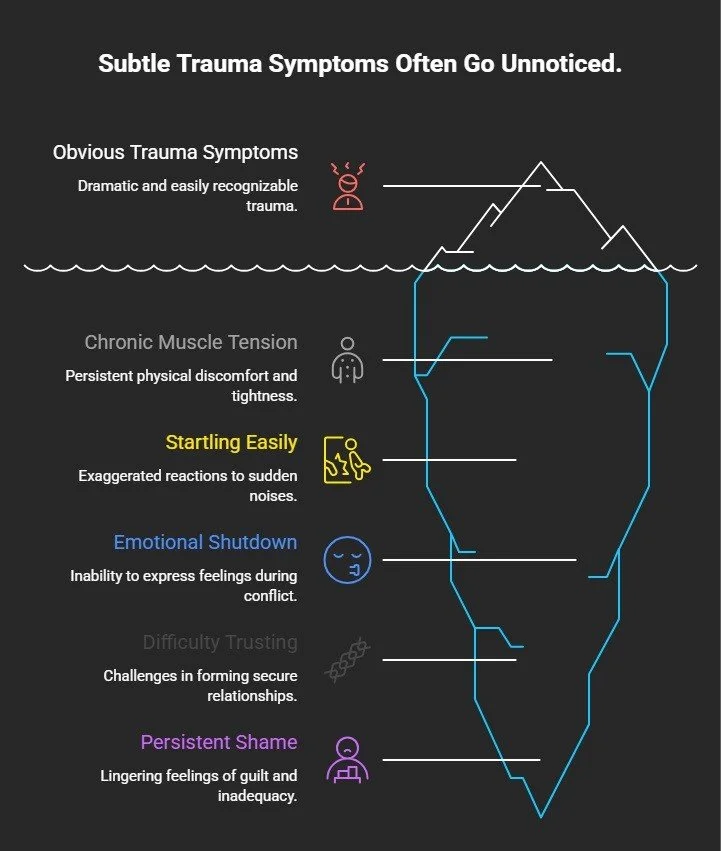
Many clients expect trauma to look dramatic. Often, it doesn’t.
Common trauma symptoms include:
Chronic muscle tension
Startling easily
Emotional shutdown during conflict
Difficulty trusting others
Persistent shame
Some people experience looping thoughts. Others feel sudden emotional flooding. These are also signs of trauma, even if you can’t connect them to one clear memory. High-functioning adults often carry emotional trauma quietly. It tends to surface most in close relationships, where vulnerability lowers defenses.
What Your Inner Dialogue Reveals
Pay attention to the story you tell yourself about yourself.
Do you believe you're fundamentally broken? That bad things happen because you deserve them? That you need to be perfect to be worthy of love? These aren't just "negative thoughts." They're often trauma symptoms written in your internal language.
I had a client once who couldn't accept compliments without immediately deflecting or finding evidence against them. We discovered this pattern started after childhood experiences taught her that visibility meant danger. Her self-criticism wasn't a personality flaw; it was a protection strategy that had outlived its usefulness.
| Adaptive Response (Then) | Problematic Pattern (Now) |
|---|---|
| Hypervigilance kept you safe in an unpredictable environment | You can't relax even in safe spaces; always scanning for threats |
| Shutting down emotions helped you survive overwhelming situations | You feel numb or disconnected from joy, sadness, and connection |
| People-pleasing minimized conflict in a volatile home | You can't identify your own needs or set healthy boundaries |
| Independence meant you didn't burden unreliable caregivers | Asking for help feels impossible; you're exhausted from doing everything alone |
When Your Body Keeps the Score
You may notice your body reacting before your thoughts catch up. Headaches. Digestive discomfort. Racing heart in mild conflict.
The American Psychological Association highlights the connection between trauma exposure and long-term physical stress responses.
If your body activates in situations that seem objectively safe, that’s one of the more telling signs of trauma. Your nervous system may still be operating from an earlier threat. This is often when the question circles back: do I need trauma therapy if my body won’t settle?
Knowing how the process unfolds can make that decision clearer, especially when you learn more about how trauma therapy is structured and paced.
A Practical Self-Check
Instead of asking whether your experience was “bad enough,” consider this:
Do certain memories still trigger strong emotion or avoidance?
Are relationship conflicts more intense than the situation warrants?
Do you struggle with numbness or disconnection?
Have your coping strategies stopped working?
Are your trauma symptoms interfering with daily functioning?
If several resonate, exploring support may be helpful. Some people begin by learning more about how does trauma therapy work to understand what sessions actually involve before making a decision.
Trauma and Depression Often Intersect
Unresolved emotional trauma does not always show up as anxiety. Sometimes it looks like exhaustion, hopelessness, or loss of interest.
In those cases, the overlap with depression can blur the picture. Persistent low mood combined with trauma symptoms may signal the need for a layered approach, similar to what is addressed in counseling for depression.
Trauma work does not exist in isolation. It often integrates emotional regulation skills, cognitive restructuring, and relational repair.
How Trauma Therapy Differs from General Talk Therapy
General therapy explores thoughts and feelings. Trauma-focused work also addresses physiological activation and memory processing.
In structured trauma treatment, sessions are paced carefully. Safety comes first. Methods may include cognitive processing therapy, ART, or somatic-based interventions. If you’re unsure which model fits, understanding the different types of trauma therapy can clarify your options.
The goal is not to relive pain. It is to reduce its intensity so the memory becomes integrated rather than intrusive.
Clients often notice:
Reduced emotional reactivity
Improved relationship security
Less avoidance
Increased self-trust
There Could be a Heavy Cost of Waiting
Many people assume that if enough time passes, symptoms will disappear. Sometimes they soften. Often they shift forms.
Untreated patterns can shape how you respond to stress, intimacy, and authority. I’ve seen unresolved trauma surface during marriage, parenting, or career transitions.
Asking Do I need trauma therapy early can prevent years of confusion and relational strain. You do not need to wait for a crisis.
FAQs About Signs of Trauma
How do you tell if you need trauma therapy?
If past experiences still trigger strong emotional or physical reactions, interfere with relationships, or cause persistent avoidance, structured trauma support may help. Ongoing trauma symptoms are a key indicator.
Can I heal trauma without therapy?
Some mild stress responses improve with time and support. More complex or long-standing emotional trauma often benefits from guided clinical intervention.
What counts as trauma?
Trauma includes experiences that overwhelm your ability to cope and leave lasting effects. It does not have to involve physical harm to qualify.
How to deal with unresolved trauma?
Begin with grounding skills and safe relationships. If symptoms persist, trauma-focused therapy can help process memories and calm the nervous system.
What are common signs of trauma?
Common signs of trauma include hypervigilance, emotional numbing, avoidance, intrusive memories, and heightened physical stress responses.
Take the Next Step with Turner Counseling LLC
You have been managing these feelings on your own for a long time, and you don't have to do it for another day. I am here to provide the clinical expertise and the compassionate support you need to answer the question, do I need trauma therapy, with confidence.
I invite you to reach out and schedule your free therapy session so we can talk about what is possible for your future. Let’s work together to help you find the peace and the clarity you deserve at Turner Counseling LLC.