How Long Does Therapy Take for Childhood Trauma? Factors That Affect Recovery
I wish I could give you a neat answer with specific months or sessions. The truth is, childhood trauma recovery doesn't follow a fixed schedule, and that uncertainty can feel frustrating when you're ready to heal.
But here's what I can tell you: understanding how long does therapy take for childhood trauma depends on several interconnected factors, none of which mean you're doing it wrong if healing takes longer than you hoped. Your timeline is yours alone, and it unfolds based on your unique history, resources, and goals.
Why Childhood Experiences Need Different Timelines
When trauma happens during your formative years, it doesn't just create painful memories. It shapes how your brain developed, how you learned to relate to others, and what you came to believe about yourself and the world.
An adult who experiences a single traumatic event has years of prior secure attachment and healthy coping skills to draw from. But childhood trauma often means you're building those foundations for the first time, not just recovering what was lost.
Think of it this way: you're not just processing what happened. You're learning skills that many people absorbed naturally during childhood: how to regulate emotions, trust others, recognize your own needs, and believe you're worthy of care.
That's not a flaw in your healing. It's the reality of what childhood trauma takes from us.
What Actually Influences Your Trauma Healing Timeline
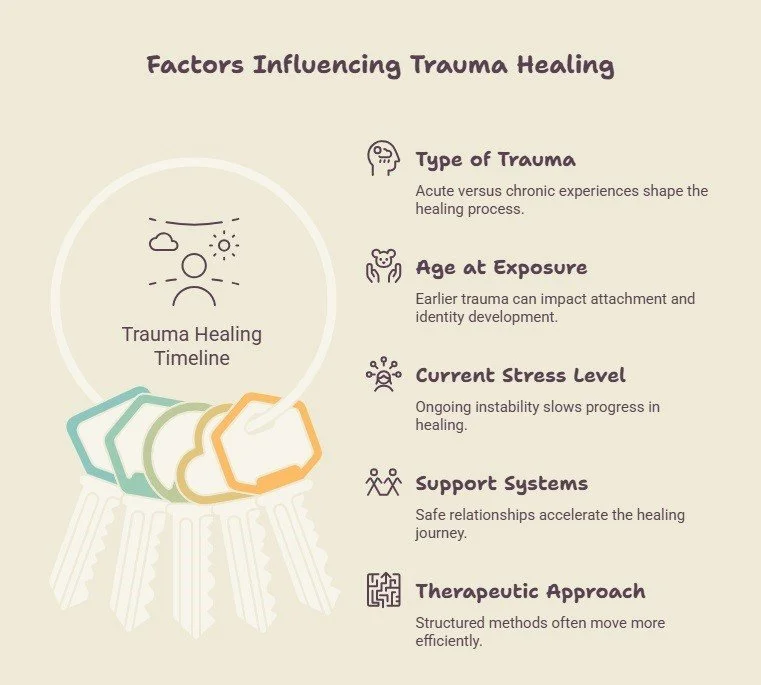
Some types of trauma therapy are designed for shorter, more intensive work, while others unfold more gradually. Along with that, there are several factors that shape the arc of childhood trauma recovery. In my experience, these tend to matter most:
Type of trauma: Acute versus chronic experiences
Age at exposure: Earlier trauma can shape attachment and identity
Current stress level: Ongoing instability slows progress
Support systems: Safe relationships accelerate healing
Therapeutic approach: Structured methods often move more efficiently
Someone asking how long does therapy take for childhood trauma often assumes the answer depends only on severity. It also depends on readiness and safety in the present.
The Phases Most People Move Through
While everyone's journey looks different, childhood trauma recovery often follows a general arc:
1. Stabilization and Safety (2-6 months)
Before diving into painful memories, you need tools to manage what comes up. This phase focuses on grounding techniques, understanding your triggers, and building distress tolerance. Some people feel impatient here, wanting to "get to the real work." But this foundation determines how effectively the later phases go.
2. Processing and Integration (6 months - 2+ years)
This is where you work directly with traumatic memories and the beliefs they created. The timeline varies wildly based on how much material needs processing and how your system responds. Some weeks you'll make breakthroughs. Other times you'll need to pause and consolidate gains before moving forward.
3. Reconnection and Growth (ongoing)
Eventually, therapy shifts from "healing what's broken" to "building what's possible." You're learning who you are beyond survival mode. Many people continue some level of therapeutic support during this phase, though sessions might spread out to biweekly or monthly.
| Trauma Complexity | Typical Timeline Range | Key Factors |
|---|---|---|
| Single-incident childhood trauma | 6-12 months | Shorter duration, focused memory work, existing coping skills |
| Repeated trauma, one context | 1-2 years | Multiple memories to process, relationship patterns to address |
| Complex developmental trauma | 2-4+ years | Attachment wounds, identity formation, skill-building alongside processing |
| Severe, chronic abuse with current life stressors | 3-5+ years | Stabilization needs, ongoing crises, rebuilding fundamental capacities |
When Progress Doesn't Feel Linear
Here's something nobody warns you about: childhood trauma recovery rarely moves in a straight line.
You'll have weeks where everything clicks. Patterns that controlled you for years suddenly loosen. You handle situations that would have destroyed you months earlier. Then something happens- an anniversary, a stressful event, a seemingly random Tuesday- and you're back in old patterns, wondering if anything actually changed.
This isn't regression. It's how healing actually works.
Your nervous system is learning new pathways, but the old ones don't disappear. They just become less automatic over time. What looks like "going backward" is often your system integrating new learning at a deeper level.
I worked with someone who spent eighteen months in trauma-focused therapy and felt frustrated that she still had hard days. Then she realized something: her hard days now looked like her good days used to. The floor had risen, even though she could still see the ceiling.
What Speeds Up or Slows Down the Process
There are situations where the trauma healing timeline extends:
Ongoing contact with unsafe family members
Co-occurring anxiety or depression
Substance use
Major life transitions
Therapy may also slow temporarily when new memories surface. That doesn’t mean it isn’t working. It often means deeper layers are being accessed.
Consistency matters more than intensity. Weekly sessions almost always produce better outcomes than sporadic appointments.
Sometimes, your own expectations and patience with yourself matter too. I've watched people heal faster once they stopped judging themselves for needing time. The energy you spend criticizing your pace is energy unavailable for actual healing.
Milestones That Matter More Than Months
Instead of counting sessions, pay attention to functional changes. How long does therapy take for childhood trauma to improve your daily life? That's the question that actually matters.
Notice when you:
Recognize triggers before they completely hijack you
Have conflict without assuming relationships are ending
Experience joy without waiting for disaster
Set boundaries that would have felt impossible before
Trust your perceptions instead of constantly doubting yourself
Sleep more consistently or wake up less exhausted
These shifts indicate real healing, regardless of how many months you've been in therapy.
The Question Beneath the Question
When people ask how long does therapy take for childhood trauma, they're often really asking: "When will I stop hurting?" or "How long until I'm normal?"
I understand that desperation. But here's a reframe that might help: therapy for childhood trauma isn't about returning to some previous state. It's about becoming someone new, someone who carries their history without being crushed by it.
You're not trying to erase what happened. You're building a relationship with yourself and your past that allows you to live fully in the present. That's not a destination you arrive at and then stop. It's a capacity you develop and continue to deepen.
Childhood Trauma Recovery FAQs
How long does it take to recover from childhood trauma?
Recovery is a gradual process that varies for everyone. Some people find significant relief from specific symptoms in 3 to 6 months of specialized therapy, while others may work on complex attachment patterns for a year or more.
Can childhood trauma be cured?
While "cured" might not be the right word, trauma can be fully integrated. This means the memories are still there, but they no longer cause emotional or physical pain. You can reach a point where your past no longer interferes with your ability to live a joyful life.
Why does childhood trauma take so long to heal?
Early trauma affects the development of the nervous system and core beliefs. Because these patterns were formed during your most formative years, they are deeply ingrained. Healing requires retraining the brain and body to feel safe, which takes time.
Is it worth starting therapy if I’m already an adult?
Absolutely. It is never too late to heal. The brain remains moldable throughout adulthood, meaning it can always learn new ways of functioning. Many of my clients find that addressing childhood trauma later in life gives them a sense of freedom they never thought possible.
What is the fastest way to heal from childhood trauma?
Evidence-based modalities like ART are generally the most efficient ways to process traumatic memories. However, the "fastest" way is the one that respects your need for safety; trying to rush through trauma work can often lead to setbacks.
Ready to Start Your Recovery?
You have been carrying these early wounds for a long time, and you don't have to do it alone anymore. I am ready to help you find the healing and the joy you deserve through specialized therapy tailored to your unique story. I invite you to take a courageous step and reach out for support today.
Contact Turner Counseling LLC to schedule your free 30-minute consultation so we can discuss how to help you find your way back to peace. Let’s work together to build a future where your past is no longer a burden.